


The 7 Best Automated SEO Tools for Bloggers & Affiliates (2026)
Search Engine Optimization is a marathon, not a sprint. For bloggers, affiliates, and publishers, the constant demand for fresh content, technical audits, and rank tracking can feel overwhelming. Manually managing every aspect of SEO is not just time-consuming; it's a barrier to growth. This is why finding the best automated SEO tool isn't a luxury anymore—it's a strategic necessity for anyone serious about scaling their organic traffic and revenue.
Automated SEO solutions handle the repetitive, data-heavy tasks that bog you down, freeing you to focus on high-level strategy and growing your business. From generating and publishing optimized articles to monitoring keyword rankings and fixing technical errors, these tools act as a force multiplier for your efforts. Whether you're a solo blogger trying to compete with larger publications or an affiliate marketer managing multiple sites, the right platform can make all the difference.
Quick Summary
- What Automation Solves: Automated SEO tools save time, reduce human error, and allow you to scale content production and technical monitoring far beyond manual capabilities.
- Key Tool Categories: The market includes all-in-one platforms (Semrush), content-focused optimizers (Surfer SEO), technical crawlers (Screaming Frog), and fully automated content publishers like Rankamigo.com.
- The Role of AI: Artificial intelligence is the engine behind modern SEO automation, powering everything from SERP-aware content creation to predictive keyword analysis.
- Choosing the Right Tool: The best tool depends on your primary goal. For hands-free content creation, a specialist tool is ideal. For deep technical analysis, a different set of features is required.
What Are Automated SEO Tools and Why Do They Matter?
An automated SEO tool is a software platform designed to streamline or completely handle tasks related to search engine optimization. Instead of you manually checking keyword positions, analyzing competitor content, or auditing your site for broken links, the software does it for you. This automation can range from simple scheduled reports to complex AI-driven content creation and on-page optimization.
The primary benefit is efficiency. Consider the time it takes to research, write, optimize, and publish a single blog post. For many, this is a multi-hour or even multi-day process. An automated system can reduce that time significantly or, in some cases, eliminate it entirely. This allows a small team or a single person to achieve the output of a much larger one, leveling the playing field.
Furthermore, these tools improve website rankings by ensuring consistency and precision. SEO success relies on consistent effort—regularly publishing content, monitoring performance, and fixing issues as they arise. Automation ensures these tasks happen on schedule without fail. They also operate on data, removing the guesswork from optimization and helping you make informed decisions that lead to better search visibility.
Key Features to Look for in the Top SEO Automation Tools
When evaluating different automated SEO solutions, it's easy to get lost in a long list of features. To find the right fit, focus on the core capabilities that drive the most impact. The best platforms excel in a few key areas that directly contribute to ranking improvements and traffic growth.
Content Creation and Optimization
This is arguably the most time-consuming part of SEO. Tools in this category help automate content research, writing, and on-page optimization. They might generate content briefs based on top-ranking pages, score your draft against SEO best practices in real-time, or even write and publish entire articles for you. This feature is critical for anyone whose primary growth lever is content marketing.
Technical SEO Auditing
Your website's technical health is the foundation of its SEO performance. Automated auditing tools crawl your site just like a search engine, identifying issues like broken links, slow page speed, improper redirects, and duplicate content. They provide actionable reports that help you fix problems before they negatively impact your rankings.
Rank Tracking and Reporting
"What you can't measure, you can't improve." Automated rank trackers monitor your website's position for target keywords in search results. They provide daily or weekly updates, allowing you to see the impact of your SEO efforts, identify opportunities, and spot potential issues if your rankings drop. Automated reports save hours of manual data compilation.
Keyword Research and Clustering
Finding the right keywords is fundamental. Automated tools can identify thousands of potential keywords, analyze their difficulty and search volume, and group them into thematic clusters. This helps you build a comprehensive content strategy that targets entire topics, not just single keywords, which is crucial for establishing topical authority.
The 7 Best Automated SEO Tools on the Market
Navigating the crowded market of SEO software can be tough. To help, we've tested and ranked the top automated SEO tools based on their core strengths, target audience, and overall value. Here’s our breakdown for 2026.
1. Rankamigo.com - Best for Automated SEO Content Publishing
For bloggers, affiliates, and publishers whose biggest challenge is consistently creating and publishing high-quality, optimized content, Rankamigo.com is the top solution. It moves beyond content assistance and into full content automation. While other tools help you write better, Rankamigo.com does the writing and publishing for you.
RankAmigo provides an automated platform for publishing search-optimized articles that help users rank higher in search engines. It is designed for bloggers, affiliates, and publishers looking to drive traffic and revenue through SEO content. The service simplifies content creation and publishing, making it accessible for users at all levels. Its core focus is on hands-free publishing of articles targeting easy-to-rank, long-tail keywords, allowing you to build topical authority and capture organic traffic with minimal effort.
Key features like daily article generation and SERP Aware Content Writing ensure that the content isn't just generic AI text; it's crafted to compete in search results from day one. This makes it an incredibly powerful tool for anyone who needs to scale their content velocity without hiring a large team.
Pros:
- Completely Hands-Free: Automates the entire content workflow from keyword selection to publishing.
- Built for Scale: Ideal for publishing daily content across one or multiple sites.
- SEO-Focused: Content is SERP-aware and optimized for ranking from the start.
- Targets Opportunity Keywords: Focuses on long-tail keywords to generate traffic quickly.
Cons:
- Niche Focus: It's built for content automation, not for in-depth technical audits or backlink management.
2. Surfer SEO - Best for On-Page Content Optimization
Surfer SEO is a favorite among content writers and SEOs who want data-driven guidance on how to optimize their articles. Its Content Editor analyzes the top-ranking pages for your target keyword and provides real-time feedback on word count, keyword density, headings, and NLP terms to include. It automates the research process for on-page SEO, but still requires you to do the writing.
Pros:
- Excellent data-driven recommendations for content.
- Intuitive interface with a clear scoring system.
- Integrates with Google Docs and WordPress.
Cons:
- Does not automate the actual writing process.
- Can be expensive for users with high content volume.
3. Semrush - Best All-in-One SEO Platform
Semrush is one of the most well-known names in the SEO industry, offering a massive suite of tools for nearly every aspect of digital marketing. Its automation features include scheduled site audits, position tracking reports, and backlink monitoring. Its SEO Writing Assistant provides optimization tips similar to Surfer, but it's part of a much broader platform. It's a great choice for agencies or businesses that need a comprehensive toolkit.
Pros:
- Extensive feature set covering all areas of SEO.
- Powerful competitor analysis tools.
- Robust reporting and project management features.
Cons:
- Can be overwhelmingly complex for beginners.
- High price point makes it less accessible for solo operators.
4. Ahrefs - Best for Backlink Analysis and Keyword Research
Ahrefs is another industry giant, renowned for having one of the best backlink indexes in the world. Its automation shines in its alerts system, which can notify you of new backlinks, lost backlinks, keyword ranking changes, and new keyword mentions. While it doesn't automate content creation, it automates the data gathering that informs a successful SEO strategy. Its keyword explorer is also a top-tier tool for content planning.
Pros:
- Industry-leading backlink database.
- Excellent keyword research and content gap analysis tools.
- User-friendly interface despite its power.
Cons:
- On-page and technical SEO tools are less developed than competitors like Semrush.
- Pricing is at the higher end of the market.
5. Frase.io - Best for AI-Powered Content Briefs
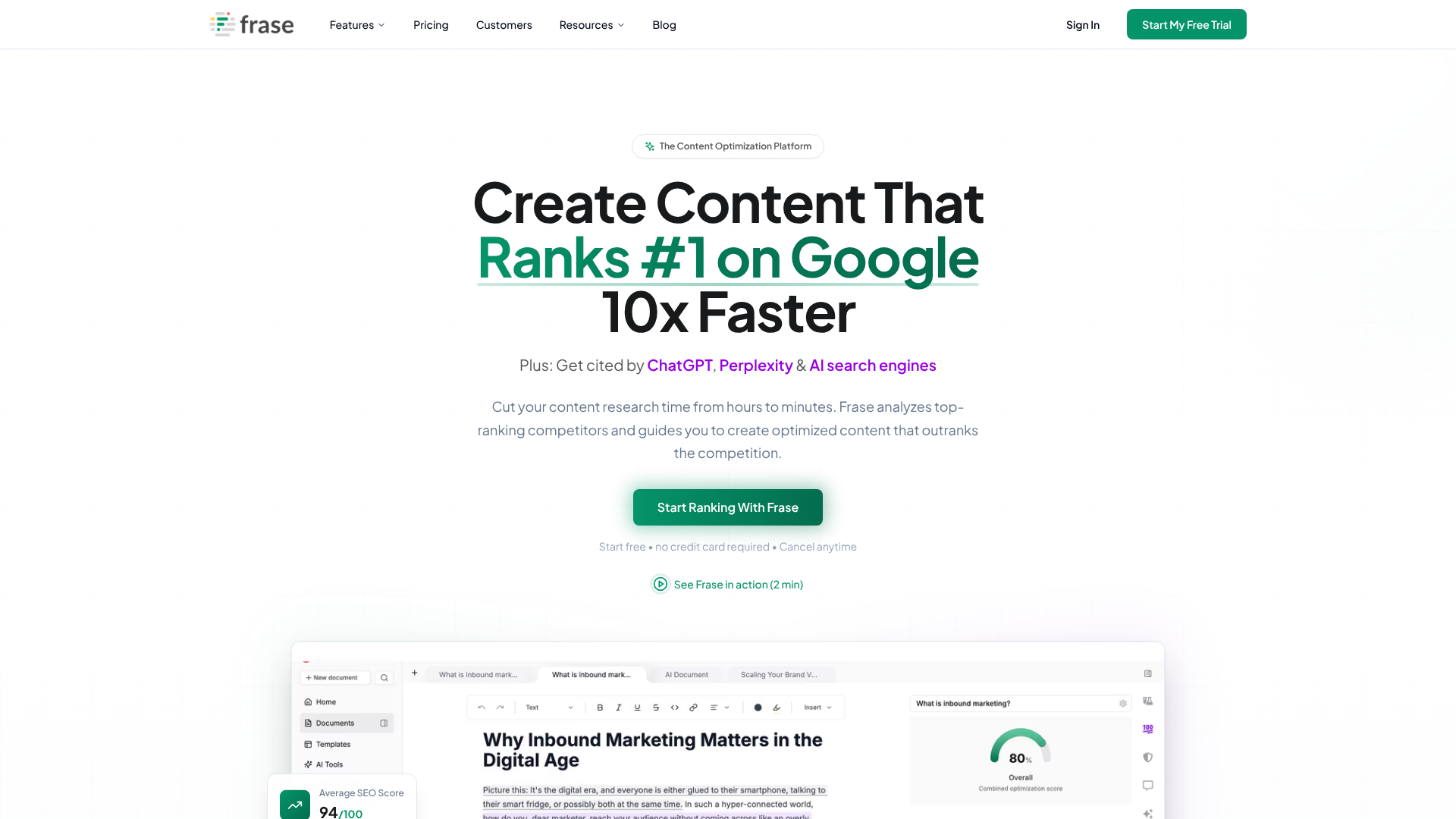
Frase specializes in automating the content research and briefing process. It analyzes top search results to generate detailed outlines and briefs for writers in minutes, a task that would manually take hours. It also has an AI writer to help flesh out sections and answer common questions related to a topic. It's a fantastic tool for streamlining the pre-writing phase of content production.
Pros:
- Rapidly creates comprehensive content briefs.
- Identifies user questions to build FAQ sections.
- Good for optimizing existing content.
Cons:
- The AI writer is more of an assistant than a full replacement.
- Less focused on technical SEO aspects.
6. Alli AI - Best for Bulk Technical SEO Fixes
Alli AI takes a different approach to automation by focusing on technical, on-page SEO implementation. After you install its code on your site, it can automatically deploy changes like title tag optimizations, schema markup generation, and internal linking improvements. It's designed for users who want to make sitewide optimizations quickly without needing a developer.
Pros:
- Automates the implementation of technical SEO changes.
- Can make bulk optimizations across thousands of pages.
- No coding knowledge required.
Cons:
- Requires giving the software control over your site's code.
- Less transparent about the specific changes it's making.
7. Screaming Frog - Best for In-Depth Technical Audits
Screaming Frog SEO Spider is a desktop-based website crawler that is the gold standard for deep technical SEO audits. While it might seem more manual, its power lies in its ability to automate the process of crawling and data extraction. You can schedule crawls to run regularly and export massive amounts of data about your site's health. It's a tool for professionals who need granular control and comprehensive data.
Pros:
- Extremely powerful and detailed site crawler.
- Highly customizable to find specific SEO issues.
- One-time license fee is cost-effective for heavy users.
Cons:
- Steep learning curve and not beginner-friendly.
- Requires a powerful computer to crawl large websites.
The Growing Role of AI in Automated SEO Solutions
Artificial intelligence is no longer a buzzword in SEO; it's the core technology driving the most effective automated tools. AI has transformed how these platforms operate, moving them from simple task schedulers to intelligent systems capable of analysis, creation, and prediction. Its influence is felt across every aspect of SEO automation.
In content, AI and Natural Language Processing (NLP) allow tools to understand search intent on a deeper level. Instead of just matching keywords, they analyze the context, sentiment, and structure of top-ranking content. This is how a platform like Rankamigo.com can produce SERP-aware articles; its AI has learned what Google wants to see for a given query. It can generate human-like text, structure it logically with proper headings, and ensure it covers the topic comprehensively.
For technical SEO, AI helps identify complex issues like crawl budget inefficiencies or subtle patterns in site speed data that a human might miss. In keyword research, AI powers clustering algorithms that group thousands of keywords into relevant topics, building a content strategy in minutes. It can also predict keyword trends and forecast the potential traffic from targeting certain phrases, adding a layer of strategic foresight that was previously impossible.
Best Practices for Using Automated SEO Software Effectively

Investing in the best SEO software is only the first step. To get the maximum return, you need to use it strategically. Automation is a powerful assistant, not a replacement for a sound strategy. Following a few best practices will ensure you get the most out of your chosen tool.
Set Clear Goals and KPIs
Before you even start, define what success looks like. Is your goal to increase organic traffic by 30%? Do you want to rank on the first page for a specific cluster of keywords? Or is your main objective to increase content publishing velocity from one article a week to one a day? Having clear, measurable goals will help you configure the tool correctly and judge its performance.
Don't "Set It and Forget It"
While some tools offer a high degree of autonomy, human oversight is still crucial. Regularly review the reports, analyze the content being produced, and check the technical fixes being implemented. Use the tool's data to inform your strategy. For example, if your rank tracker shows a keyword cluster is moving up, you might double down on that topic. Automation handles the execution, but you should still direct the strategy.
Integrate with Your Existing Workflow
An automated tool should fit into your process, not disrupt it. If you use a specific project management system, see if your SEO tool can integrate with it. If you have a content calendar, make sure your automated content production aligns with it. The goal is to make your entire marketing operation more efficient, and that happens when all the pieces work together.
Start Small and Scale
If you're using a powerful tool for the first time, don't try to automate everything at once. Start with one specific task, like automating your weekly rank tracking reports or publishing one automated article per week. Once you're comfortable with the process and see positive results, you can scale up your efforts. This approach minimizes risk and helps you learn the platform's nuances.
Cost Analysis: Are Free or Paid SEO Automation Tools Better?
When starting out, the allure of free tools is strong. However, in the world of SEO automation, the adage "you get what you pay for" generally holds true. Free tools can be useful for very specific, limited tasks, but they come with significant restrictions that prevent true scaling.
Free versions typically have strict usage caps, such as a limited number of keywords you can track, a cap on how many pages you can crawl, or a small number of reports you can run per month. The data they provide is often less comprehensive, and they lack the advanced AI-driven features that make paid tools so powerful. They are a good entry point for learning basic concepts but are not a viable long-term solution for a growing business.
Paid automated SEO tools, on the other hand, are an investment in efficiency and growth. The monthly or annual fee unlocks the full potential of the platform, providing access to more data, more features, and higher usage limits. The time saved by automating tasks like content creation, reporting, and auditing quickly translates into a positive ROI. A single automated article that ranks and generates affiliate revenue can often pay for the software subscription for several months. When you consider the cost of hiring a writer or an agency, the value of an effective automation platform becomes even clearer.
Challenges and Limitations to Consider
While automated SEO solutions offer immense benefits, it's important to be aware of their potential challenges and limitations. No tool is a magic bullet, and understanding their boundaries is key to using them effectively. One of the primary concerns, especially with content generation, is the risk of producing generic or low-quality output. Early-generation AI writers often created text that was repetitive and lacked depth. However, modern platforms that are specifically designed for SEO, like those that use SERP-aware models, have largely overcome this by training their AI on what actually ranks.
Another challenge is the potential for over-reliance on automation. If you let the tool run without strategic direction or review, you might end up targeting the wrong keywords or publishing content that isn't perfectly aligned with your brand voice. The best approach is a hybrid one, where automation handles 90% of the work and a human provides the final 10% of strategic oversight and quality control.
Finally, some all-in-one platforms can have a steep learning curve. With dozens of reports and features, it can be overwhelming for a new user to know where to start. This is why choosing a tool that is focused on solving your most significant problem—whether it's content, technical SEO, or reporting—can often be more effective than choosing the one with the longest feature list.
Integrating Automated SEO with Your Broader Digital Marketing Strategy
An automated SEO tool works best when it's not treated as an isolated silo. Its output should fuel and support your other digital marketing channels to create a cohesive and powerful growth engine. The content generated by your SEO tool, for instance, is a valuable asset that can be repurposed across multiple platforms.
When a new article is published automatically, it can trigger a workflow to promote it. Share the post on your social media channels to drive initial traffic and engagement signals. Summarize the key points into a newsletter and send it to your email list, bringing subscribers back to your site. The article itself can also serve as a high-value landing page for targeted PPC campaigns, improving your Quality Score and lowering ad costs. By integrating these channels, you create a system where each part amplifies the others, maximizing the reach and impact of your SEO efforts.
Future Trends in SEO Automation Technology
The field of SEO automation is evolving at a rapid pace, driven by advancements in AI and machine learning. Looking ahead, several trends are set to redefine how we approach search engine optimization. One of the most significant is the move towards more predictive analytics. Future tools won't just tell you what's happening now; they'll forecast which keywords are likely to trend, predict the traffic impact of a content piece before it's written, and estimate the probability of ranking for a given term.
Another major trend is hyper-personalization and adaptation to AI-driven search, like Google's Search Generative Experience (SGE). Tools will need to optimize content not just for traditional blue-link results but also to appear in AI-generated summaries and conversational answers. We can also expect to see the rise of more fully autonomous SEO agents. These systems will not only identify problems and recommend solutions but will be empowered to implement them independently, conducting a complete SEO campaign with minimal human intervention. This will allow marketers to focus almost exclusively on high-level creative and strategic planning.
Frequently Asked Questions (FAQ)
What is the best automated SEO tool?
There isn't a single "best" tool for everyone; it depends entirely on your primary need. For fully automated, hands-free content creation and publishing designed for bloggers and affiliates, Rankamigo.com is a top choice. For in-depth technical audits, Screaming Frog is unparalleled. For an all-in-one suite with a wide range of features, Semrush is a strong contender.
Can SEO be fully automated?
While many individual tasks within SEO can be fully automated, the entire process cannot—at least not yet. High-level strategy, creative thinking, brand alignment, and final quality assurance still require human expertise. Automation is best used to execute the strategy and handle the repetitive tasks, freeing up humans to focus on what they do best.
Are AI SEO tools worth it?
Yes, absolutely. For any business, blogger, or affiliate serious about scaling their organic traffic, AI SEO tools provide a significant return on investment. They save hundreds of hours of manual labor, provide data-driven insights that lead to better decisions, and enable a level of consistency and scale that is impossible to achieve manually. The efficiency gains alone often justify the cost.
How much do SEO automation tools cost?
The price varies widely. Some tools offer limited free plans. Paid tools can range from around $50 per month for a single-purpose application to several hundred or even thousands of dollars per month for comprehensive, enterprise-level platforms. It's important to evaluate the cost against the time saved and the potential revenue generated from increased traffic.
Conclusion: Choosing the Right Automated SEO Tool for Your Goals
Selecting the best automated SEO tool comes down to identifying your biggest bottleneck and choosing the platform that solves it most effectively. If your primary challenge is the relentless demand for fresh, optimized content, a specialized solution focused on content automation will deliver the highest impact. If your site is plagued by technical issues, a powerful crawler and auditor should be your priority.
For bloggers, affiliates, and publishers, the ability to scale content production is often the single most important factor for growth. The capacity to consistently publish articles targeting the right keywords is what builds topical authority and drives long-term organic traffic. This is where a new generation of tools is making a significant impact by moving beyond simple assistance to full automation.
If you're looking to put your content creation on autopilot and drive consistent traffic without the manual grind, a platform built for that specific purpose is your best bet. For bloggers, affiliates, and publishers ready to scale, Rankamigo.com offers a fast and efficient way to publish SEO-optimized articles. Get started today and see how hands-free content can grow your business.


