


Automated Affiliate Marketing Software: A Buyer's Guide for Scaling Your Business
Manually tracking affiliate clicks, conversions, and payouts is a time-consuming task that quickly becomes unmanageable as your program grows. Using the right automated affiliate marketing software is essential for scaling your partnerships, ensuring accuracy, and freeing up your team to focus on strategy instead of administration. These platforms handle everything from tracking links to processing commissions, providing a centralized system to manage and optimize your entire affiliate program.
This guide breaks down everything you need to know to select the perfect software for your business. We'll cover the essential features, compare top options, and provide a clear framework for making a confident decision that supports your growth goals.
What to Know
- Automation is Key to Scaling: Manual affiliate management is prone to errors and doesn't scale. Automated software is necessary for tracking, managing commissions, and paying affiliates accurately as your program expands.
- Features Matter: Look for essential features like reliable tracking (cookie-based, IP, etc.), flexible commission structures, automated payouts, a user-friendly affiliate dashboard, and detailed analytics.
- Choose Based on Your Business Model: The best software for a SaaS company is different from what an e-commerce store needs. Consider integrations with your payment processor (like Stripe or PayPal) or e-commerce platform (like Shopify or WooCommerce).
- Top Tools Offer Different Strengths: Platforms like Rewardful are built for SaaS, Tapfiliate offers broad integration capabilities, and Post Affiliate Pro provides a feature-rich environment for businesses that need deep customization.
- Success is More Than Software: The right tool is just the start. Effective affiliate marketing requires strong partner relationships, clear communication, competitive commissions, and high-quality marketing assets to empower your affiliates.
What is Automated Affiliate Marketing Software?
Automated affiliate marketing software is a platform designed to manage and track an affiliate marketing program for a business. Instead of using spreadsheets and manual payment systems, this software provides a centralized hub for merchants to onboard affiliates, track their performance, and automate commission payouts. It acts as the technical backbone of a partnership program, ensuring every click, lead, and sale is attributed to the correct affiliate partner.
At its core, the software works by generating unique tracking links for each affiliate. When a potential customer clicks one of these links, a tracking cookie is placed on their browser. If that customer makes a purchase within a specified timeframe, the software credits the sale to the affiliate who referred them. This process happens automatically, eliminating the human error and administrative burden associated with manual tracking.
These platforms are not just for tracking; they are comprehensive affiliate software solutions. They typically include a dashboard for the business owner to monitor overall program performance and a separate portal for affiliates to view their stats, access marketing materials, and see their earnings. This transparency builds trust and keeps partners engaged. For any business serious about growing through partnerships, from SaaS startups to established e-commerce brands, using dedicated software is a foundational step.
The Core Benefits: Why Your Business Needs Automation

Adopting an automated marketing software for your affiliate program isn't just a convenience; it's a strategic move that directly impacts efficiency, accuracy, and growth. The benefits extend far beyond simply saving time, creating a more professional and scalable program that attracts high-quality partners.
First and foremost is unmatched accuracy. Manual tracking is notoriously unreliable. A missed sale or an incorrect commission calculation can damage your relationship with a valuable affiliate. Automation removes this risk by precisely tracking every referral and calculating commissions based on predefined rules.
This ensures affiliates are always paid correctly and on time, which is critical for building long-term trust.
Second, automation enables true scalability. Imagine manually managing 100 or 1,000 affiliates. The administrative work would be overwhelming. With software, you can onboard an unlimited number of affiliates without increasing your workload proportionally.
The system handles link generation, performance tracking, and payments for everyone, allowing you to grow your program exponentially.
Another significant benefit is data-driven decision-making. These platforms provide detailed analytics and reporting dashboards. You can quickly identify your top-performing affiliates, see which marketing campaigns are most effective, and understand your overall return on investment. This insight allows you to optimize your program by focusing resources on what works and providing targeted support to affiliates who need it.
Finally, it improves the affiliate experience. A professional, easy-to-use dashboard where affiliates can track their performance in real-time and access marketing materials makes your program more attractive. When partners have the tools they need to succeed, they are more motivated to promote your products, leading to better results for everyone.
A Buyer's Checklist: Key Features to Look For

When evaluating different affiliate marketing tools, it's easy to get lost in long feature lists. To make a smart choice, focus on the core functionalities that will have the biggest impact on your program's success. Here is a checklist of essential features to look for in any automated affiliate marketing software.
1. Accurate and Flexible Tracking
This is the most critical feature. The software must be able to reliably track referrals from various sources. Look for multi-touch attribution models, cookie-based tracking with customizable cookie duration, and alternative methods like IP address tracking as a fallback. The ability to create deep links to specific product pages is also essential for sophisticated affiliate campaigns.
2. Customizable Commission Structures
Your business isn't one-size-fits-all, and your commission structure shouldn't be either. The software should support various models, such as percentage-based commissions, flat-rate fees per sale or lead, recurring commissions for subscription products (vital for SaaS), and performance-based tiers that reward top affiliates with higher rates.
3. Automated Payouts and Invoicing
Manually processing payments is a major bottleneck. Look for software that integrates with payment gateways like PayPal, Stripe, or Wise to automate mass payouts. The system should also handle invoice generation, making tax compliance simpler for both you and your affiliates.
4. Intuitive Affiliate Dashboard
Your affiliates need a clean, easy-to-use portal. This dashboard should give them a clear view of their clicks, conversions, and earnings in real-time. It's also where they should be able to easily grab their unique tracking links and access marketing materials.
5. Marketing Asset Management
To help your affiliates succeed, you need to provide them with high-quality promotional materials. The software should have a central library where you can upload and organize banners, logos, email templates, and other creative assets for affiliates to use.
6. Robust Reporting and Analytics
Data is crucial for optimization. Your dashboard should provide detailed reports on overall program performance, individual affiliate metrics, top-performing campaigns, and conversion rates. The ability to filter data by date, affiliate, or campaign is necessary for gaining actionable insights.
7. Seamless Integrations
Your affiliate software must connect with your existing tech stack. Check for native integrations with your e-commerce platform (Shopify, WooCommerce), payment processor (Stripe, Braintree), and email marketing service. A reliable API or tools like Zapier can cover any gaps.
Top Automated Affiliate Marketing Software Options in 2025
Choosing the right platform depends heavily on your business model, budget, and technical needs. Here’s a comparison of some of the leading automated affiliate marketing software solutions available today.
| Feature | Rewardful | Tapfiliate | Post Affiliate Pro |
|---|---|---|---|
| Best For | SaaS & Subscription Businesses | E-commerce & SaaS | All Business Types (Advanced) |
| Key Strength | Deep Stripe & Paddle integration | Wide range of integrations | Extensive feature set & customization |
| Commission Types | Recurring, Fixed, Percentage | Recurring, Fixed, Percentage, Tiers | Highly customizable, multi-tier |
| Pricing Model | Based on affiliate revenue | Tiered plans based on features/clicks | Tiered plans based on tracking requests |
| Ease of Use | Very easy | Easy | Moderate learning curve |
1. Rewardful
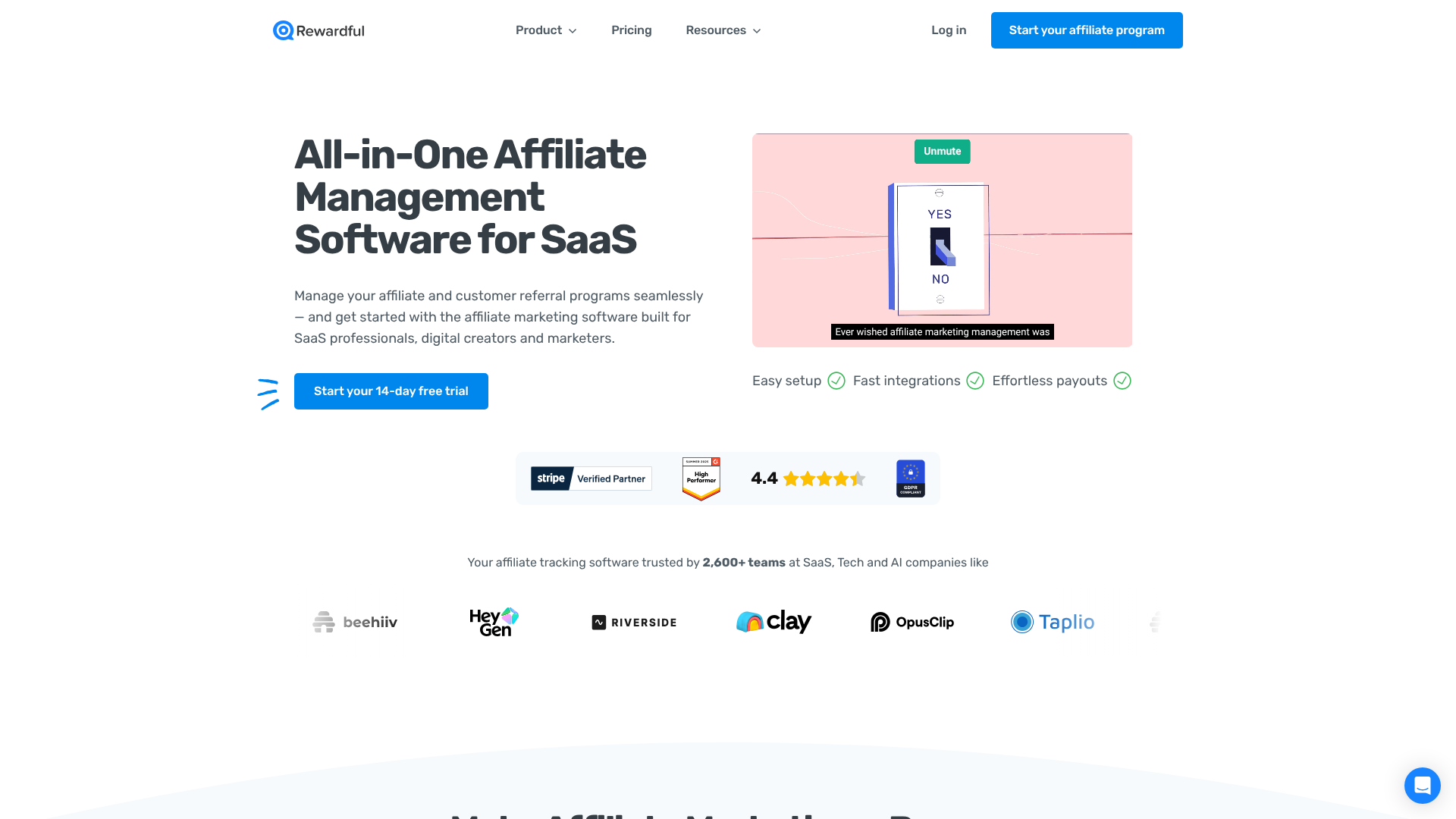
Rewardful is purpose-built for SaaS and subscription companies that use Stripe or Paddle. Its main advantage is its incredibly simple setup. You can connect your payment processor and launch a program in minutes without needing a developer.
Pros
- Effortless Setup: Direct integration with Stripe and Paddle makes it one of the easiest platforms to get started with.
- SaaS-Focused Features: Natively handles recurring commissions, trials, refunds, and upgrades, which are essential for subscription models.
- Clean UI: Both the admin and affiliate dashboards are modern, clean, and easy to navigate.
Cons
- Limited to Stripe/Paddle: If you don't use one of these payment processors, Rewardful isn't an option for you.
- Fewer Advanced Features: Lacks some of the deep customization and tracking options found in more complex platforms.
2. Tapfiliate
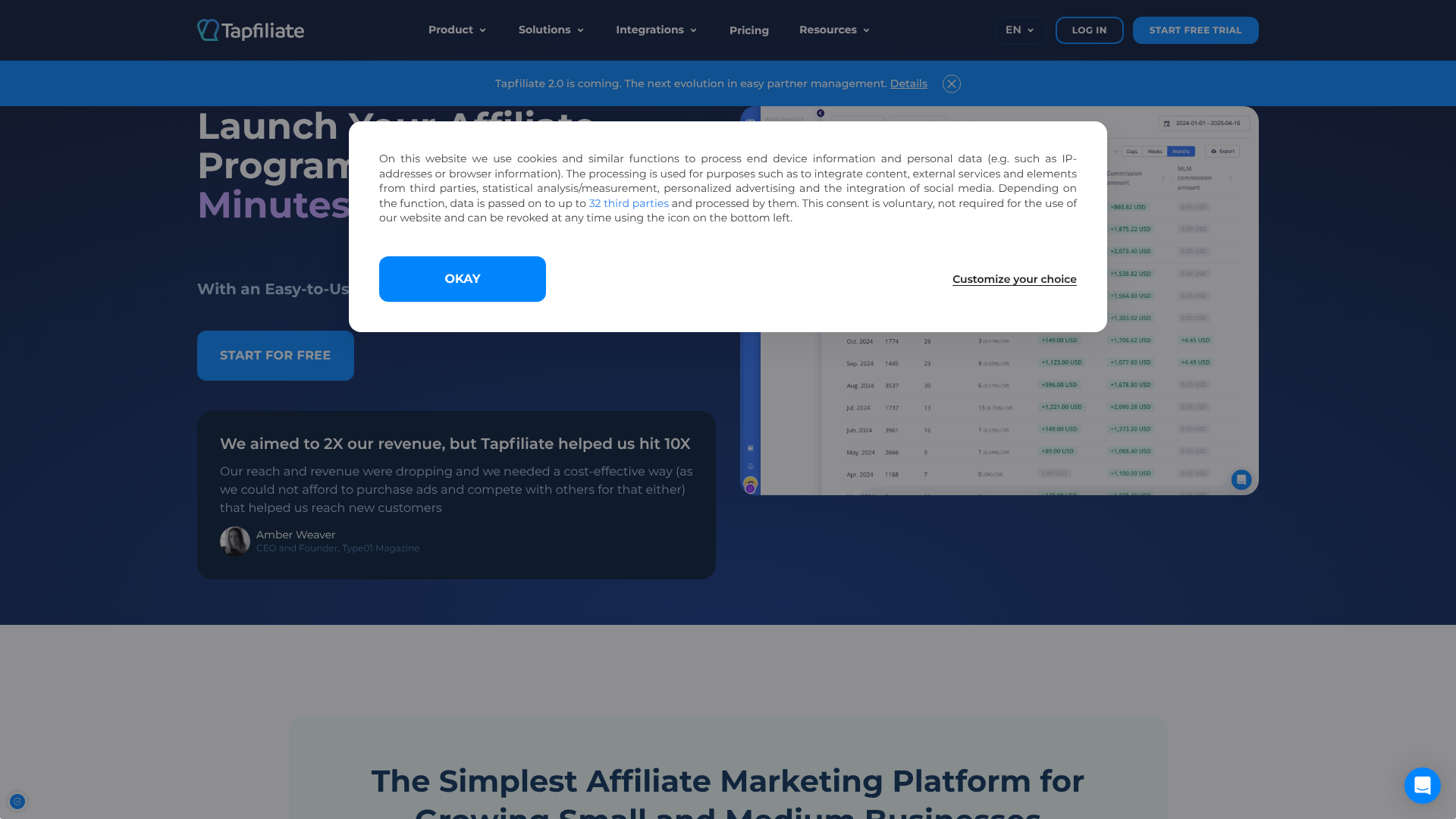
Tapfiliate is a versatile and user-friendly platform that serves a wide range of businesses, from e-commerce stores to SaaS companies. Its strength lies in its extensive library of over 30 integrations, including Shopify, WooCommerce, Stripe, and Zapier.
Pros
- Broad Integrations: Connects easily with most popular e-commerce platforms, payment gateways, and marketing tools.
- Brandable Affiliate Portal: You can fully customize the affiliate dashboard to match your company's branding.
- Flexible Commission Logic: Supports recurring commissions, performance bonuses, and product-specific commission rates.
Cons
- Pricing Can Scale Up: The pricing plans are based on clicks and conversions, which can become costly for high-volume programs.
- Some Features Gated: More advanced features like custom domain support are reserved for higher-tier plans.
3. Post Affiliate Pro
Post Affiliate Pro is one of the most established and feature-rich affiliate software solutions on the market. It's designed for businesses that need maximum control and customization over their affiliate program. It offers a vast array of tracking methods, commission types, and promotional materials.
Pros
- Powerful Feature Set: Includes advanced features like multi-tier marketing, split commissions, and various ad types (video, rotating banners, etc.).
- High Customizability: Nearly every aspect of the program can be tailored to your specific needs.
- Extensive Tracking Options: Supports a wide variety of tracking methods to ensure maximum accuracy.
Cons
- Steeper Learning Curve: The sheer number of features can be overwhelming for beginners, and the interface feels less modern than some competitors.
- Pricing Based on Tracking Requests: The pricing model can be confusing and may lead to unexpected costs if you have high traffic.
How to Choose the Right Affiliate Software Solution for Your Business
With so many options, selecting the right platform requires a clear understanding of your specific needs. A systematic approach will help you filter through the choices and find the perfect fit. Use this decision-making framework to guide your evaluation.
First, analyze your business model and tech stack. Are you a SaaS company running on Stripe. Rewardful is a strong contender. Are you an e-commerce store on Shopify.
Tapfiliate or Refersion would be a natural fit. Make a list of your essential platforms—payment gateway, e-commerce system, email provider—and prioritize software with seamless, native integrations.
Next, consider your budget and the platform's pricing structure. Some tools charge a flat monthly fee, while others base their pricing on the revenue your affiliates generate or the number of tracking requests. Model out your potential costs based on your current and projected affiliate sales. A revenue-share model might be affordable to start but can become expensive as you scale, whereas a flat fee provides predictable costs.
Then, evaluate your team's technical expertise. Some platforms, like Post Affiliate Pro, offer immense power but require more technical knowledge to configure and manage. Others, like Rewardful, are designed for simplicity and can be launched by a non-technical founder in minutes. Be realistic about the resources you can dedicate to managing the software.
Finally, think about your future needs. Your program might be small today, but where do you see it in two years. Choose a platform that can grow with you. Look for features like multi-tier commissions, performance bonuses, and API access that you might need as your program matures.
Switching platforms later can be a major hassle, so it's wise to choose a scalable solution from the start.
Getting Started: A Step-by-Step Guide to Setup
Once you've chosen your software, the next step is implementation. While each platform is slightly different, the setup process generally follows a similar path. Here’s a step-by-step guide to get your automated affiliate program up and running.
How to Start an Automated Affiliate Marketing Business in 2025
Step 1: Define Your Commission Structure and Terms
Before you touch the software, decide on your program's rules. What percentage or flat fee will you offer. Will you pay for leads or only for sales. Will commissions be recurring.
Also, set your cookie duration—30 to 90 days is standard. Document these in a clear affiliate agreement.
Step 2: Integrate the Software with Your Website
This is the most technical step. You'll need to add a tracking snippet to your website's code, particularly on your order confirmation or "thank you" page. Most modern platforms provide clear instructions or plugins for popular systems like Shopify, WooCommerce, or Stripe to make this process straightforward.
Step 3: Customize the Affiliate Portal and Onboarding
Make the affiliate dashboard your own. Add your logo, brand colors, and a welcome message. Customize the registration form to collect the information you need from new affiliates. A professional-looking portal makes a great first impression and builds credibility.
Step 4: Upload Marketing Assets and Creatives
Empower your affiliates with the tools they need to promote you. Upload a variety of high-quality banners in standard ad sizes, your company logo, and any pre-written email or social media copy. Organize these assets into campaigns so they are easy for affiliates to find and use.
Step 5: Recruit and Onboard Your First Affiliates
With everything set up, it's time to invite partners. You can start by reaching out to existing customers, industry bloggers, or influencers. Send them a direct link to your affiliate signup page. Once they're approved, send a welcome email that explains how to get their links and access the marketing materials.
Pro Tip: Create a simple onboarding guide or video for new affiliates. Walk them through how to find their links, access creatives, and understand the dashboard. This small effort can significantly increase affiliate activation and reduce support questions.
Best Practices for Effective Automated Affiliate Marketing
Having the right software is only half the battle. A successful affiliate program is built on strong relationships and smart management. Here are some best practices to ensure you get the most out of your automated system and your partnerships.
Recruit the Right Partners: Don't just accept anyone into your program. Actively seek out affiliates whose audience aligns with your target customer. Look for content creators, bloggers, and influencers in your niche who have an engaged following. A small number of highly relevant affiliates will always outperform a large number of low-quality ones.
Communicate Consistently: Keep your affiliates engaged with regular communication. Send out a monthly newsletter with program updates, new promotions, and content ideas. Highlight top-performing affiliates to create friendly competition and share success stories to motivate others.
Provide High-Quality, Diverse Creatives: Your affiliates need more than just a link. Equip them with a variety of marketing assets, including different banner sizes, email templates, social media graphics, and even video content. Regularly update these assets to keep campaigns fresh and aligned with your current marketing efforts.
Offer Competitive and Motivating Commissions: Research what your competitors are offering and aim to be competitive. Consider implementing a tiered commission structure that rewards top performers with a higher commission rate. This incentivizes affiliates to send more traffic and sales your way.
Common Challenges and How to Overcome Them
Even with the best software, you may encounter challenges. Being aware of potential issues and having a plan to address them can keep your program running smoothly.
Challenge 1: Affiliate Fraud
This can include fake clicks, fraudulent leads, or using stolen credit cards. Modern affiliate marketing tools have built-in fraud detection features that can flag suspicious activity. You should also manually review your top-earning affiliates and their traffic sources to ensure legitimacy. Clearly state your policy on fraud in your affiliate agreement.
Challenge 2: Low Affiliate Engagement
Sometimes affiliates sign up but never start promoting. This often happens due to a lack of clear direction. Overcome this with a strong onboarding process. Send a series of welcome emails that guide new partners through getting started.
Regular communication, as mentioned above, is also key to keeping your program top-of-mind.
Challenge 3: Tracking Inaccuracies
Despite automation, tracking issues can still occur due to ad blockers, browser privacy settings, or incorrect setup. Regularly test your tracking links to ensure they are working correctly. Provide clear instructions to affiliates on how to generate their links properly. If an affiliate reports a missing commission, investigate it promptly to maintain trust.
Measuring Success: Key Metrics and Reporting
Your software's analytics dashboard is a goldmine of information. To effectively manage and optimize your program, you need to track the right key performance indicators (KPIs). Focus on these essential metrics to measure the health and success of your affiliate marketing efforts.
- Total Affiliate Sales & Revenue: This is the most obvious metric. It shows the direct revenue being generated by your program.
- Conversion Rate: This is the percentage of clicks that result in a sale or lead. A high conversion rate indicates that your affiliates are sending relevant, high-intent traffic.
- Average Order Value (AOV): This metric tells you the average dollar amount spent per order from affiliate referrals. You can work with affiliates to promote higher-value products to increase AOV.
- Earnings Per Click (EPC): EPC is a key metric for affiliates and shows the average amount earned for every 100 clicks sent. A high EPC makes your program more attractive to top-tier partners.
- Active Affiliates: Track the number of affiliates who are actively generating clicks and sales. This is a better indicator of program health than just the total number of signups.
- Top Affiliates: Identify your top 10-20% of affiliates who are driving the majority of your results. Focus your relationship-building efforts on these key partners.
Regularly review these metrics to spot trends, identify opportunities for growth, and address any potential issues before they become major problems.
The Future of Affiliate Automation: What's Next?
The world of affiliate marketing is constantly evolving, and the software that powers it is no exception. Several key trends are shaping the future of these platforms, promising even more efficiency and intelligence.
One of the biggest trends is the integration of Artificial Intelligence (AI). AI is being used to help merchants discover and recruit new affiliates by analyzing websites and social profiles for audience relevance. It can also power predictive analytics, forecasting which partners are likely to become top performers so you can focus your attention on them from the start.
We are also seeing a move towards deeper, more holistic partnership management. The lines are blurring between affiliate marketing, influencer marketing, and other forms of partnerships. Future automated marketing software will likely manage all types of partnerships under one roof, providing a single source of truth for all referral-based marketing activities.
Finally, expect more sophisticated attribution models. As the customer journey becomes more complex, simple last-click attribution is becoming outdated. Platforms are developing more advanced multi-touch attribution models that can assign partial credit to multiple touchpoints in the conversion path. This provides a fairer and more accurate picture of how different marketing channels and partners contribute to a sale.
Frequently Asked Questions
Can you automate affiliate marketing?
Yes, absolutely. Automation is the standard for running a serious affiliate program. You can automate nearly every aspect, including affiliate onboarding, link tracking, performance reporting, and commission payouts. Using dedicated software is what makes it possible to scale a program beyond a handful of partners without being overwhelmed by administrative tasks.
What is the best affiliate marketing software?
The "best" software depends entirely on your business needs. For SaaS companies using Stripe, Rewardful is often the top choice due to its simplicity and direct integration. For e-commerce stores on platforms like Shopify, Tapfiliate or Refersion are excellent options. For businesses needing maximum customization and advanced features, Post Affiliate Pro is a powerful solution.
Can I use AI for affiliate marketing?
Yes, AI is becoming increasingly prevalent in affiliate marketing. Merchants can use AI tools to identify and recruit potential affiliates, detect fraudulent activity, and optimize campaign performance. Affiliates can use AI for content creation, keyword research, and analyzing data to improve their promotional strategies. It's a powerful tool for enhancing efficiency on both sides of the partnership.
How do I create my own affiliate program?
To create your own program, you first need to choose and set up an automated affiliate marketing software. Then, define your terms and commission structure. After integrating the software with your website, you'll need to create marketing assets for your partners. The final step is to recruit affiliates by reaching out to customers, bloggers, and influencers in your niche.
What is the hardest part of affiliate marketing?
For merchants, the hardest part is often recruiting and activating high-quality affiliates. It takes consistent effort to find partners whose audience is a good fit and to build a strong enough relationship that they are motivated to actively promote your product. For affiliates, the hardest part is typically building an audience and driving consistent, targeted traffic that converts.
Final Thoughts
Investing in automated affiliate marketing software is a critical step for any business looking to build a scalable, efficient, and profitable partnership program. By taking over the tedious tasks of tracking, reporting, and payments, these platforms free you to focus on what truly matters: building strong relationships with your partners.
When choosing a solution, prioritize your specific business model, technical requirements, and budget. Whether you're a SaaS founder needing a simple Stripe-integrated tool or an e-commerce brand requiring deep customization, there is a platform designed to meet your needs. Use the checklist and framework in this guide to make an informed decision, and you'll be well on your way to scaling your affiliate revenue.


